
Calculator · chart · printable ruler
Ruler Drop Test
Catch a falling ruler, type where you caught it, and get your reaction time in milliseconds.
Type where the top of your thumb caught the ruler, one box per drop. Up to 5 drops.
Average reaction time
–
Take the on-screen test too and we'll put the two side by side.
How to do the ruler drop test
You need a 30 cm ruler, a partner and a table.
- The catcher sits with their forearm resting on a table, hand over the edge, thumb and first finger open about 2 cm apart.
- The partner holds a 30 cm ruler vertically from the top end, with the zero mark level with the top of the catcher's thumb.
- Without warning, and after a different wait each time, the partner lets go.
- The catcher pinches the ruler as fast as they can without moving their arm.
- Read the mark level with the top of the thumb. That's the distance the ruler fell, in cm.
- Repeat for five drops and type each distance into the calculator. Use the average.
NASA's classroom version of this activity is aimed at grades 5–12 and averages five drops, which is why the calculator has five boxes. If the ruler slips through entirely, don't count it; drop again.
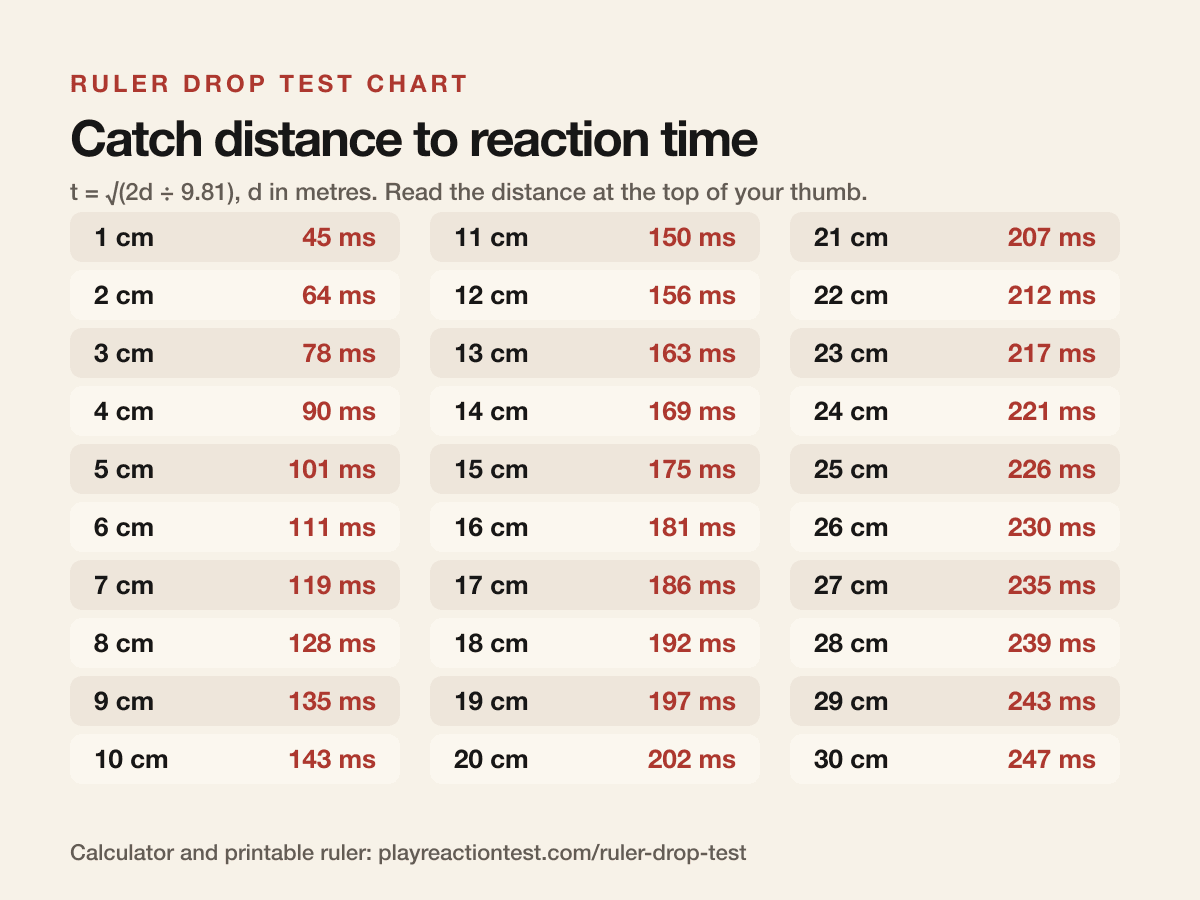
Ruler drop test chart
Each catch distance converted with t = √(2d / 9.81):
| Distance | Reaction time | Distance | Reaction time |
|---|---|---|---|
| 1 cm | 45 ms | 16 cm | 181 ms |
| 2 cm | 64 ms | 17 cm | 186 ms |
| 3 cm | 78 ms | 18 cm | 192 ms |
| 4 cm | 90 ms | 19 cm | 197 ms |
| 5 cm | 101 ms | 20 cm | 202 ms |
| 6 cm | 111 ms | 21 cm | 207 ms |
| 7 cm | 119 ms | 22 cm | 212 ms |
| 8 cm | 128 ms | 23 cm | 217 ms |
| 9 cm | 135 ms | 24 cm | 221 ms |
| 10 cm | 143 ms | 25 cm | 226 ms |
| 11 cm | 150 ms | 26 cm | 230 ms |
| 12 cm | 156 ms | 27 cm | 235 ms |
| 13 cm | 163 ms | 28 cm | 239 ms |
| 14 cm | 169 ms | 29 cm | 243 ms |
| 15 cm | 175 ms | 30 cm | 247 ms |
| Inches | Reaction time |
|---|---|
| 1 in | 72 ms |
| 2 in | 102 ms |
| 3 in | 125 ms |
| 4 in | 144 ms |
| 5 in | 161 ms |
| 6 in | 176 ms |
| 7 in | 190 ms |
| 8 in | 204 ms |
| 9 in | 216 ms |
| 10 in | 228 ms |
| 11 in | 239 ms |
| 12 in | 249 ms |
Printable reaction time ruler
Print a ruler marked in milliseconds and skip the maths. It prints in two parts that you glue together, centimetres down one side and milliseconds from 80 to 250 ms down the other. Print at 100% ("Actual size"); each sheet has a 10 cm check line so you can confirm the scale with a real ruler.
A4 ruler (PDF)US Letter ruler (PDF)
The formula
A dropped ruler starts at rest and speeds up under gravity, so the distance it falls in time t is d = ½gt². Rearranged for time: t = √(2d / g), with d in metres and g = 9.81 m/s².
Worked example: you catch it at 20 cm. d = 0.20 m. 2 × 0.20 = 0.40. 0.40 ÷ 9.81 = 0.0408. √0.0408 = 0.202 s, which is 202 ms. Note that time doesn't grow in step with distance: 5 cm is 101 ms but 20 cm, four times as far, is only twice as long.
GCSE required practical
UK GCSE biology courses use the ruler drop to investigate reaction time. The usual set-up keeps the method fixed and changes one thing:
- Independent variable: what you change, such as dominant vs non-dominant hand, or before and after practice.
- Dependent variable: the catch distance, converted to reaction time.
- Control variables: same ruler, same catcher position, same starting gap between finger and thumb, a random wait before each drop.
- Repeat readings and a mean: several drops per condition, any anomalous catch repeated, then the mean.
Your exam board's specification has the exact method it expects. Class mode below handles the repeats and the means.
Class results table
Up to 30 names with three drops each. It saves in this browser as you type and exports as a CSV for a spreadsheet.
| Name | Drop 1 (cm) | Drop 2 (cm) | Drop 3 (cm) | Mean | Remove |
|---|---|---|---|---|---|
| – |
Advantages and disadvantages
Advantages: it costs nothing, needs no electricity or screen, works for a whole class at once, and leaves out the screen and mouse delay that online tests include.
Disadvantages: the person dropping can give away the moment with their hand or face, so the catcher may anticipate. Rulers bend and slip. Fingers that start further apart add distance. Reading the mark by eye is only accurate to a few millimetres, which matters most for short catches.
Ruler drop vs online test
The two measure the same thing in different ways. The ruler has no screen or mouse delay but depends on a human release and a careful reading. The online reaction test uses a random wait, so you can't anticipate it, but includes your hardware's delay. Do both and compare: the calculator above shows your last on-screen median beside your ruler average. For more on what reaction time is, read what is reaction time.
FAQ
Ruler drop test questions
What does the ruler drop test measure?
Your reaction time to something you see: the gap between the ruler starting to fall and your fingers closing on it. The distance it fell converts into milliseconds.
How to do a ruler test?
A partner holds a ruler with the zero between your open finger and thumb, drops it without warning, and you catch it. Read the distance at the top of your thumb, repeat five times, and convert each distance with t = √(2d/9.81).
How to calculate reaction time with ruler drop test?
Convert the catch distance to metres, double it, divide by 9.81 and take the square root. That gives seconds; multiply by 1,000 for ms. 20 cm gives √(0.4 ÷ 9.81) = 0.202 s, or 202 ms.
What is the ruler drop test in GCSE biology?
A class practical where students measure reaction time by catching a dropped ruler, usually repeating drops and comparing a mean before and after a change. Check your own exam board's specification for the exact method it expects.
How fast is a 12 year old reaction time?
We haven't found a source we could check for that age, so we don't give a number. Teachers can collect their own class results with class mode on this page and export them as a spreadsheet.
Keep playing
More reaction tests
 Reaction Time TestWait for green, then press. Five tries, your median in ms.
 F1 Reaction TestFive red lights, a random hold, then lights out. Jump starts get caught.
 Sound Reaction TestHear the beep, press. Includes a sprint start with the 0.100 s rule.
 Choice Reaction TestPress the key that matches the light, with 2, 4 or 6 choices.
 Go/No-Go TestPress fast for green, hold still for red. 30 signals.
 Reaction Time DuelA duel link with the same delays, two players on one screen, or a live race.